From Corn to Cabernet
A burgeoning wine industry takes Colorado agriculture uptown
From the August 17, 2009 issue of High Country News by Christie Aschwanden
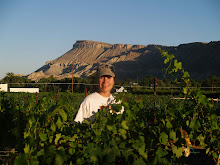
Bruce Talbott built his reputation on apples and peaches. A congenial middle-aged farmer with a tidy moustache and a boyish grin, the VP of Talbott Farms manages more than 400 acres, most of them perched on a verdant bench overlooking the small Western Slope town of Palisade, Colo. To the north rise the towering Mancos shale formations for which this small farming community was named. To the south and east, the alpine forests of the Grand Mesa push skyward above the red desert. Even on this late May day, the mountain's upper flanks, which top out at nearly 11,000 feet, still harbor caches of snow. The Colorado River runs through Palisade, bringing irrigated life to the arid landscape. Outside Talbott's office, tiny green peaches hang in the manicured orchard.
This community of 3,000 looks like classic rural America with its ranch houses, lean-to fruit stands and sleepy streets. But just a few miles to the west, the city of Grand Junction is inching ever closer. Western Colorado's major metropolitan area, Grand Junction is home to about 54,000 people. And more are coming: Fueled by a flood of amenity migrants, retirees and oil and gas field workers, Mesa County has grown 5 percent faster than the rest of the state over the past decade. In the last eight years, Grand Junction -- often described as "a suburb without a city" -- has annexed nearly 4,600 acres. Surrounded by public land, the city has had little choice but to expand into its agrarian surroundings, gobbling up choice farmland in the process.
Just west of Palisade lies the growing community of Clifton-Fruitvale. True to its name, Clifton-Fruitvale was once covered in orchards, but today the names Delicious, Rome and Winesap refer to residential streets rather than the apple varietals that grew here. Even as the residents of Clifton-Fruitvale consider annexation by Grand Junction, Palisade's farmers fret about holding back the tide of subdivisions. Since 1980, Palisade's population has doubled, and with its striking beauty, ample water and open land, the town appears ripe for even more development.
Talbott envisions a different future for his community, one that is still agricultural but centered on a fruit crop whose varietals go by names like cabernet, syrah and riesling. Wine grapes yield vastly greater profits per acre than the apples that once provided Palisade's major cash crop, and vineyards hold a certain cachet that orchards and hay fields lack. Wine appeals to yuppies and retirees and well-heeled tourists -- people with money to spend. If vineyards become more valuable than housing developments, a burgeoning wine industry just might preserve western Colorado's rural heritage. "People are far more interested in wine vineyards than in fruit. The wine industry is approaching the number-one draw for tourists in the region," says Talbott. "Holding the land base in agriculture is the most important thing to us -- subdivisions are the enemy."
This new industry could also provide a reprieve from the boom-bust economy that has long dogged this region. Where other fruits (and the oil and gas industry) have gone through multiple up-and-down cycles, wine grapes promise a more reliable future. Colorado's wine industry has been growing steadily for the past decade, and even in today's poor economy, demand for the state's wine remains high.
It's an industry that appears well-positioned to excel over the long haul. Vineyards use a fraction of the water that other crops require. That makes them well-suited to the state's arid lands, especially as climate change reduces stream flows and thirsty urban areas grab for the water now used for irrigation. Even as global warming threatens to hamstring California's wine industry, Colorado seems better able to cope with the rising temperatures, at least so far. "Global warming is probably what enabled us to grow grapes in the first place," says Colorado state viticulturist Horst Caspari. "We've gained almost two weeks in our growing season over the last 45 years."
As recently as a decade ago, the mere notion of Colorado wine was enough to turn up the nose of a wine snob. Early on, Colorado wines often had a bouquet more reminiscent of Kool-Aid than Cabernet. But the Colorado wine industry has matured over the last decade, and its products have evolved from what one critic diplomatically dismissed as "uninteresting" to fine wines worthy of national awards.
In 1990, there were only five licensed wineries in Colorado. But that year, the state Legislature created the Colorado Wine Industry Development Board (CWIDB) and by 1995, the number of wineries had risen to 13. Today, the state claims 85 wineries, and with an average annual increase in production of 20 percent since 1996, the wine industry represents Colorado's fastest-growing agricultural sector. "We were the first state in the region to create a wine board to fund research and promotion. It was very forward-thinking," says Doug Caskey, the gregarious former actor who serves as the CWIDB's executive director.
With the support of the development board and Colorado State University, which employs state viticulturist Caspari as well as state enologist Steve Menke, Colorado is ready to make the next big leap, according to syndicated columnist, Dan Berger. "Colorado is making very good wine," says Berger, a former wine reporter for the Los Angeles Times who now publishes the weekly wine commentary Vintage Experiences. "Not every winery is great, and not every bottle is a great wine, but if you go from top to bottom you find infinitely more quality wine in Colorado now than even five years ago. If the Colorado industry continues to grow like it has in the last decade, it will be in the thick of it."
When wine succeeds, other types of agriculture also benefit. Wineries attract tourists and their dollars, which are helping to drive a vigorous local-foods movement. Today, foodies seeking local wines, fruit, cheese and pastured meats flock to places like Palisade and the North Fork and Surface Creek Valleys on the Grand Mesa's south flanks. A tourist destination best known for the West's finest powder skiing, the state is reinventing itself as Wine Country USA. Even Palisade's famously delectable peaches never mustered such allure.
If not for prohibition, western Colorado might have established itself as a wine region a long time ago. In the late 1880s, Grand Junction founder George Crawford planted 60 acres of wine grapes near Palisade. At the same time, Italian immigrants planted vineyards to produce their cherished vino. But prohibition wiped out Colorado's wine production, and the state went without a commercial vineyard until the 1970s, when the Four Corners Development Project, a cooperative effort by Utah, Colorado, New Mexico and Arizona to find crops that would thrive in the arid Southwest, got under way. Grapes were just one of the test crops planted, but the experiment had a lasting impact, proving once again that traditional vinifera wine grapes could grow in Colorado.
Still, the state's wine industry did not take off for nearly two more decades. In 1985, when Talbott joined with his father and two brothers to take over the land their grandfather had farmed since 1918, the 150-acre property was planted almost entirely in apples. "Apples were the number-one crop in the 1960s, '70s and '80s, and then everything just totally crashed," says Talbott. "In 1987, the apple industry got really beat up with over-production. There was just too much fruit on the market." To make matters worse, the consolidation of grocery store chains gave an edge to big producers who could promise a 12-month supply, and China flooded the world market with cheap apple juice concentrate. "Apples (became) a commodity item, rather than something to be celebrated," Talbott says. By the early 1990s, Colorado apple producers found themselves pushed out of the industry.
Like many Colorado growers, Talbott Farms moved into peaches, still its most profitable crop. Talbott never intended to get into the wine business, but in 1999 Palisade's Plum Creek Winery made him an offer he couldn't refuse. "They came to us and said that if we planted wine grapes they'd promise to buy them," Talbott says. "They told us when and how and where to grow them. It seemed like a low-risk deal."
Talbott planted those initial grapes in 2000 and has since expanded to 115 acres, growing more than a dozen varieties including merlot, syrah and riesling, which he sells to wineries throughout Colorado. Peaches fetch a slightly higher return per acre than grapes, but combining the two crops makes economic sense, says Caspari. "You prune the peaches, then it's time to prune the grapes. Harvest times for the two crops sync well so growers can use the seasonal workforce in a complementary way."
Wineries have popped up in nearly every corner of the state, but the vast majority of Colorado's nearly 1,000 acres of vineyards lie in the state's Grand Valley American Viticultural Area, or AVA, around Grand Junction and Palisade. Other prime locations include the North Fork Valley's West Elks AVA, the Surface Creek Valley near Cedaredge, Olathe's corn country and the Four Corners region. Some growers are even planting hybrids along the Front Range near Denver. Grapes thrive in Colorado's rocky soil and they develop the best flavors and sugar profiles when grown under water stress. Unlike other crops grown in this area, grapes need little fertilizer and few pesticides, and so far the arid region has not attracted any major grape pests.
Diversifying into grapes has made his business more resilient, says Talbott. "You spread your weather risk. A cold snap in midwinter won't hurt the peaches, and a spring frost won't usually hurt the grapes. You reduce the potential for a complete wipeout." Climate change could actually help the Colorado wine industry if it continues to extend the growing season, but it also poses some worrisome risks. "Our biggest concern with global warming is the increased amplitude of extreme weather events," says Caspari. "If the extremes become more extreme, that's a big problem." Even now, unpredictable weather poses the biggest challenge to Colorado grape growers.
Talbott hopes that the vineyards will help preserve the agricultural character of Palisade, where a recent oil and gas boom brought an infusion of money from land speculators and developers. "When wine catches the imagination of the average politician and you get people interested in marketing destination tourism, you get a push to keep the area desirable," says Talbott. "Once people are aware of what we have, it makes it much more difficult for someone to come put a subdivision in the middle of all that agriculture."
The troubled economy could also end up protecting farmers, says Talbott, since the value of agricultural land has gone down. Currently, Palisade's master plan shows housing developments growing to four or five times their current size, wiping out a lot of agricultural land, says Talbott. "Right now they don't plan to save fruit except on the periphery. But as time goes on and the wine industry grows, that master plan may change."
On the other side of the Grand Mesa, 40 miles southeast of Palisade, wine is helping to revitalize Delta County's agricultural roots. Grapes have a long history in this area, although few Coloradans are aware of it. Back in the 1970s, researchers from the Four Corners Development Project planted test vines on Garvin Mesa outside of Paonia. Now, the soil on this scenic mesa overlooking Mount Lamborn nurtures some of Colorado's oldest wine grapes.
When Joan Mathewson and her husband, John, bought land at the top of Garvin Mesa in 1987 for their Terror Creek Winery, they found some of those old gewurztraminer vines still thriving despite years of neglect. The previous owner didn't know the vines were there until a retired winegrower friend from California paid him a visit. As the two were setting off on a hunting trip, "the friend discovered these old vines growing along the ground in the field. Well, they never did go hunting that day," says Joan Mathewson, a soft-spoken redhead who's been making wine at Terror Creek since 1993.
Originally from New Jersey, Mathewson spent 26 years following her geophysicist husband around the world, from Nigeria to Egypt and Tanzania. When the couple found time to vacation, they often traveled to Europe. There, they fell in love with Alsatian white wines, and Joan made it her mission to learn how to make them. She studied the wine business in Switzerland, where she labored at several wineries near Lake Geneva and eventually earned a degree in enology from L'Ecole d'Ingenieurs de Changins outside Nyon. "I had to work in the wineries first -- they wouldn't even let you apply to the school without some experience," she says.
Mathewson's professional training has helped her navigate the challenges of high-altitude grape growing. At 6,500 feet, Terror Creek claims the title of North America's highest commercial vineyard. Garvin Mesa rises above the North Fork of the Gunnison River in a gentle southerly slope, a footnote to the Grand Mesa towering above it. The winery is tucked away at the end of a steep, unpaved road, and the tasting room resembles a Swiss chalet with its sharp rooflines and European-style window boxes.
The neatly mowed lawn around the tasting room looks out on symmetrical rows of gewurztraminer, pinot noir, riesling, chardonnay and gamay noir grape vines. "There's almost 10,000 vines in that little seven acres," says Mathewson. Although the higher altitude means a shorter growing season and less production than the vineyards in Palisade's hotter, low-lying areas, Mathewson consistently produces well-received wines.
Though she doesn't keep count, "Visitation has picked up every single year," she says. "The majority of visitors come from Colorado, but we get people from all across the country and from Europe, too."
Since Terror Creek opened, the number of wineries and tasting rooms in Delta County has grown to more than a dozen. In 2003, Brent Helleckson, a former aerospace engineer, and his wife, Karen, opened Stone Cottage Cellars just down the road, on a parcel previously planted by Plum Creek, the same winery that first roped Bruce Talbott into grape-growing. Mathewson considers the Hellecksons colleagues, not competitors, noting that the rising number of wineries in the area has increased visits to her tasting room. "It encourages people to come and stay here so they can visit everyone," she says.
On this June day, a chatty couple from Virginia stopped in to taste, and bought several bottles to share with their grown children back at home. On their way out, they crossed paths with a couple from the Denver area who drove up in a sporty European convertible and left with a case in their tiny trunk.
The latest figures from the Colorado Wine Industry Development Board show that wine-related tourism alone injects more than $21 million into the Colorado economy. Add to that another $21.1 million in wine sales and the industry's worth tops $42 million per year. Articles touting Colorado wine country have turned up in publications ranging from The New York Times to USA Today and Sunset magazine.
Delta County's sluggish economy could certainly use the dollars. The local free newspaper recently ran an ad with the headline, "Need bankruptcy? Don't despair. Most Delta County incomes qualify." Indeed, Delta County is among Colorado's poorest -- its average personal income clocks in at a mere 66 percent of the state average. The coal trains that rumble through Paonia a half-dozen or more times a day (and night), shuttling loads from the three mines just east of town, provide a constant reminder of the town's dependence on coal -- a commodity likely to face tough times in a carbon-constrained economy.
The recent loss of a couple hundred coal-mining and light-industry jobs has left Delta County's economy increasingly dependent on its agricultural roots. Supporters hope the wine industry can help boost the farming community as a whole. "The wine industry has attracted more people into ag, and that's great," says Ela Family Farms president Steve Ela, who grows organic fruit on 100 acres near Hotchkiss. "It's very synergistic." Tourists who come for the wineries near Ela's orchards sometimes leave with a box of his peaches or cherries, too.
"We moved to agritourism about four or five years ago," says Kelli Hepler of the Delta County Tourism Board, which helps promote the West Elks American Viticultural Area, including Paonia and Hotchkiss. Initially, many locals resisted efforts to promote tourism, fearing newcomers would drive up property values or make a nuisance of themselves complaining about backyard junk and manure piles. Then, a few years back, a regional Slow Food USA group organized a tour of the area's farms and wineries. The event's success opened eyes, says Hepler. "This is a type of tourism that's very gentle on the resources, and locals are realizing that a llama farm or vineyard is a lot nicer to look at than a subdivision."
Wine consultant and Bethlehem Cellars winemaker Bill Musgnung, who spent most of his career working in the Oregon wine industry before moving to Paonia several years ago, predicts that Delta County may follow the example of Carlton, Ore. "Fifteen years ago, Carlton was a dinky little town just like Paonia. Then the wineries came in and now it's the number-one wine destination on the West Coast."
Hepler's group promotes agritourism on "Our Side of the Divide" with maps outlining self-guided wine, farm and bike tours, and it also helps promote farm dinners and wine tastings. Those efforts have paid off, she says. "Last year there were 38 articles written about Delta County wine." Nearly every one of Delta County's 11 wineries now hosts some kind of food and wine event, and Fresh and Wyld, a bed and breakfast inn, has brought area residents into the fold with weekly farm dinners created from locally produced ingredients and paired with local wines. But agritourism has yet to make anyone rich. "Some people are making some money on it, but no one is cashing in big time yet," says Hepler.
In fact, few are getting rich in the Colorado wine business. Despite the industry's incredible growth, profits remain slim. "Most wineries over three or five years old are making a profit," Caskey says. "Making enough to support its owners? Then you're down to maybe five or six wineries."
"The early wine industry was a romance industry," says Talbott. "It's not sustainable until the business has a cash value." The industry's sparse profits stem in part from a lack of planning, says state enologist Menke. "A lot of people just don't understand the business model," he says. Winemaking requires more than an appreciation of wine, says Musgnung; you need farming and chemistry skills as well. "A lot of people come here and they think they can translate their business experience into a winery, but it really comes down to farming, and farming isn't normal business."
With some of the world's most famous wine-producing regions suffering from overproduction -- the French are considering paying vineyard owners to stop growing grapes -- many wonder about the future. Can the Colorado wine industry sustain its double-digit growth, or will grapes join apples on the list of agricultural money-losers?
Menke believes that grapes are less likely to be vulnerable to the commoditization that befell apples. "Wine is highly dependent on the quality of the grapes," he says. "It's not actually a commodity anymore, it's more of a quality-driven product, and it's much easier for a winery to make a quality product from local grapes than from grapes brought in." Like any other fruit, grapes taste best straight from the vine, and are easily bruised by shipping.
Although nearly all of the wine made in Colorado is also sold and drunk here, locally produced wine represents only a single-digit percentage of the total wine consumed in Colorado. "We haven't even come close to saturating the Colorado market," says winemaker Bret Neal of Stoney Mesa Winery in Cedaredge, Delta County's largest and most successful winery. "Most wineries are too small to even hit liquor stores. It's mostly tourism right now."
A lack of recognition remains one of the biggest challenges still facing the Colorado wine industry, says Caspari. "We're still overcoming a stigma. Colorado's reputation might be held in higher esteem outside the state than within it," he says, noting that Colorado wines have garnered awards in competitions throughout the country. In 2003, for example, Carlson Vineyards won the "Best in the World" title at the 28th International Eastern Wine Competition's World Riesling Cup.
Colorado wine is more akin to a handcrafted microbrew than a mass-produced Budweiser, says Talbott, and thus it holds a different place in the market than those $6 bottles with cute animals on the label. "On a per-gallon cost basis, we can't compete with the big boys in California, but we can put out a great boutique product. Will we oversupply the market? Well, craft breweries have done very well even though there are dozens of them in Colorado."
"It used to be, people bought wine to celebrate -- it was a snooty beverage," says Caskey. But research linking moderate wine consumption to good health has transformed vino into what Caskey calls a "beverage of the people." That's especially true for the millennial generation. "They drink more wine and spend more money on wine than other generations," says Caskey. "If we can capture that millennial generation, then, yes, this industry is sustainable."
Talbott hopes that the new generation of wine drinkers with their enthusiasm for the "buy local" movement will foster a greater appreciation for Colorado's agricultural heritage and help protect his corner of the state from the sprawl of subdivisions. So many of the West's rural communities have been buried under generic housing developments and look-alike strip malls. "Wine is a taste of the local community," says Talbott. "It's the local flavor; that's what gives us our flair."